Twin tank water softener installation is the best choice for homes that can't afford even a few hours of hard water coming through the pipes.
Here's how to install a twin tank water softener:
Most installations take a few hours with basic plumbing experience. That said, mistakes like skipping the air gap, using the wrong lubricant, or incorrect programming can lead to leaks, hard water slipping through, or voided warranties.
If you're in the Omaha or Gretna area and want it done right the first time, JTM Plumbing & Drain offers professional water softener installation.
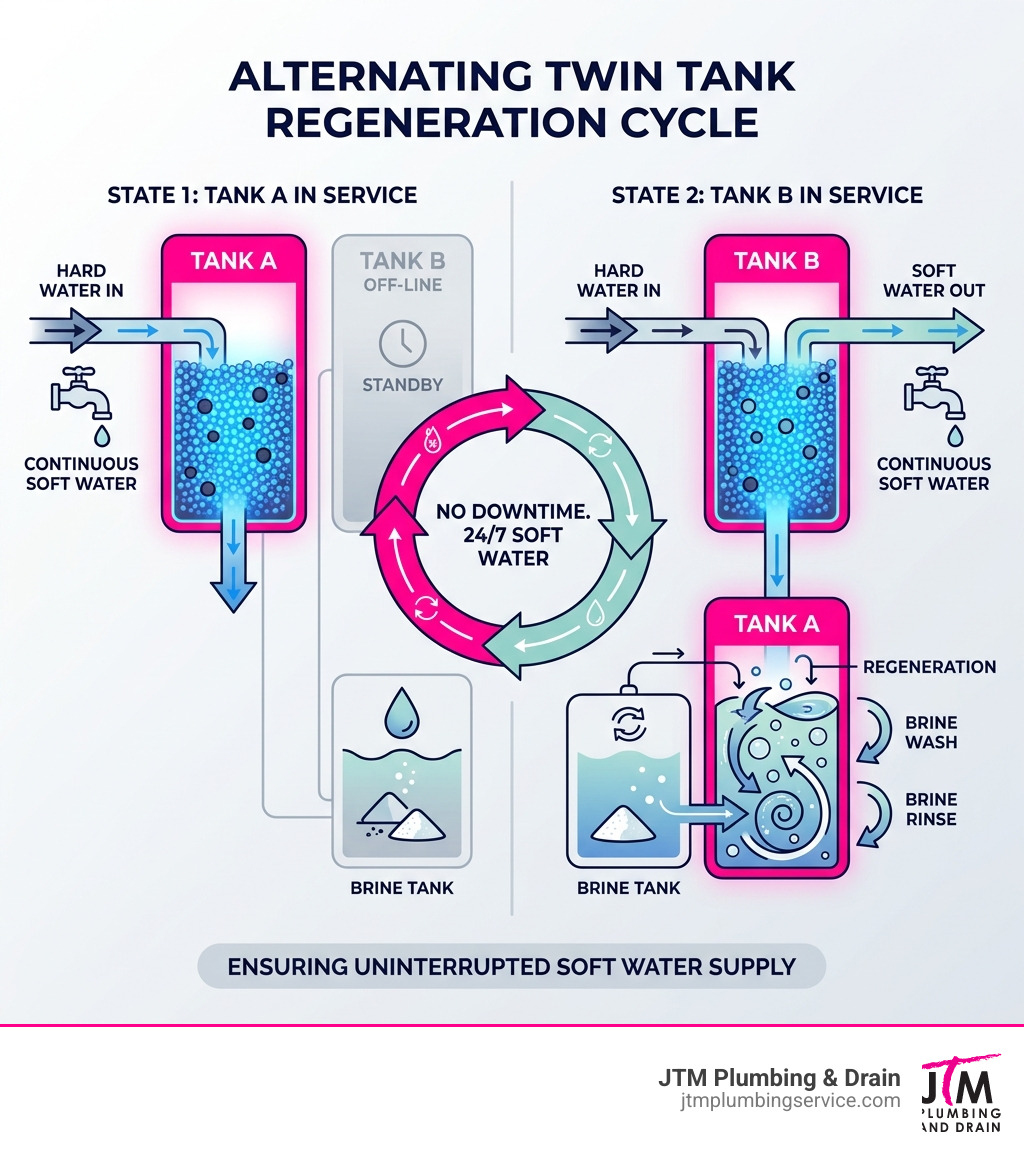
Here's the key thing that makes twin tank systems special: while one resin tank is softening your water, the other is quietly regenerating in the background. No downtime. No burst of hard water at 2 a.m. Just continuous soft water, all day, every day.
Single tank systems pause service during their regeneration cycle — typically 80 to 90 minutes — which means hard water can reach your taps, your appliances, and your water heater during that window. For a large household or a home with very hard water, that's a real problem.
Twin tanks solve it completely.
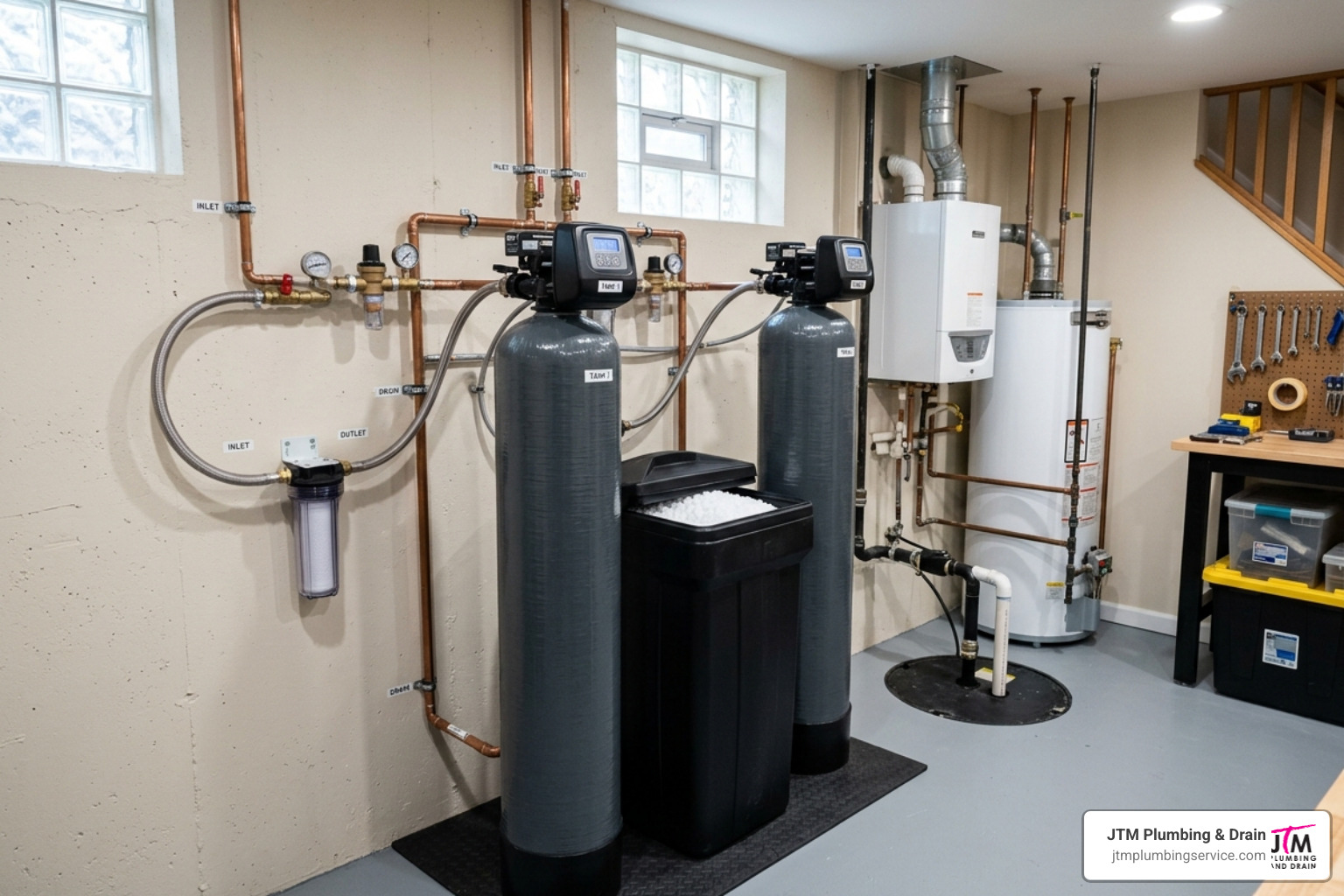
Before you start cutting pipes in your Omaha basement, we need to talk about what makes a twin tank water softener installation successful. Unlike a single-tank unit, you are dealing with two mineral (resin) tanks and a brine tank. This means you need more floor space and a very specific environment to keep the system running for its expected 10 to 15-year lifespan.
The ideal spot is near the main water line entry into your home, but after the main shut-off valve. You want to soften the water before it hits your water heater to prevent scale buildup, but you must leave at least 10 feet of piping between the softener outlet and the water heater inlet. This prevents hot water from backing up into the softener and melting the resin beads—a mistake that turns a DIY project into an expensive disaster.
Your chosen spot must be:
You can't program a twin tank system correctly without knowing exactly what's in your water. In Omaha, NE, water hardness averages around 10 grains per gallon (gpg), but this can fluctuate. If you have well water in Gretna or Springfield, you might also be dealing with iron.
For every 1 ppm (part per million) of soluble iron, you need to add 4 grains to your hardness setting. If your water test shows 10 grains of hardness and 1 ppm of iron, you program the unit for 14 grains. This ensures the system regenerates often enough to keep the resin clean.
| Feature | Single Tank System | Twin Tank System |
|---|---|---|
| Soft Water Supply | Interrupted during regen | 24/7 Continuous |
| Regeneration Water | Uses hard water | Uses soft water (more efficient) |
| Salt Usage | Time-based (often wasteful) | Demand-based (highly efficient) |
| Resin Life | Standard | Extended (due to soft water cleaning) |
For more details on why the Twin‑Tank (Dual‑Tank) Configuration Explained 🇺🇸 April 2026 is superior, it’s all about that "standby" tank ready to take over the second the first one reaches capacity.
Don't be the person who starts a plumbing job only to realize halfway through that you're missing a crucial fitting. We recommend gathering everything beforehand.
Required Tools:
If this sounds like a lot of prep, don't worry. Deciding on a Water Softener is the first step, and we’re here to help with the heavy lifting if needed.
Now for the main event. Ensure you have plenty of light and a bucket handy for the inevitable small spills.
Turn off the main water supply to the house. Open the lowest faucet in the home (usually a basement sink or outdoor bib) to drain the lines and relieve pressure. If you have an electric water heater, turn off the breaker; if it's gas, turn it to "pilot."
Most modern systems, like the Lancaster TTLX or Water Soft Twin Series, come with a bypass valve. Assemble this onto the control valve first. This allows you to divert water around the softener if you ever need to perform maintenance.
Identify the section of the main cold water line where the softener will "interrupt" the flow. Cut the pipe and install the necessary adapters.
We highly recommend using flexible stainless steel connectors. They make the twin tank water softener installation much easier and help dampen any vibration or "water hammer" in the pipes.
In a twin tank setup, both mineral tanks connect to a single master control valve. Follow the manufacturer’s diagram carefully to ensure the distributor tubes are seated correctly. If you're unsure about the pipe sizing or flow rates, check our page on Water Softener Installations.
The drain line is where the "salty" wastewater goes during regeneration.
For more on managing your home's water quality, see Water Conditioning from JTM Plumbing.
Once the plumbing is secure, it's time to bring the "brains" of the system to life.
Finally, load your salt. We recommend solar salt (pellets or crystals). It's purer than rock salt and less likely to cause "bridging" or "mushing" in the tank. To understand the long-term perks, check out the Benefits of Owning a Water Softener.
A twin tank water softener installation is a "set it and forget it" system for the most part, but it still needs a little love.
Sometimes salt forms a hard crust (a bridge) over the water, or a thick sludge (mushing) at the bottom. If you notice your water feels hard but the salt level isn't dropping, grab a broom handle and gently break up any crust. To prevent this, don't overfill the tank; keeping it 1/2 to 2/3 full is usually best.
Once a year, we recommend:
For comprehensive care of your Home Water Systems, regular maintenance is the secret to avoiding emergency repairs.
Technically, yes, if you have experience with pipe cutting and basic programming. However, twin systems are more complex than single-tank units. You must navigate local plumbing codes in cities like Papillion or La Vista, ensure proper grounding, and calculate exact hardness settings. If you’re uncomfortable cutting into your main water line, it’s safer to call a pro. You can find more about local services at Water Softener Omaha.
The main difference is the "standby" tank. In a single tank system, when the resin is full of minerals, the system stops providing soft water to clean itself. In a twin tank system, the control valve simply flips the flow to the second tank. You get soft water 24/7, and the system uses soft water to clean the dirty tank, which is much more efficient.
This is usually a programming error or a flow meter issue. If the control valve doesn't "see" water flowing (due to a jammed turbine or a loose wire), it won't know when to switch. Check the display to see if the flow rate increases when you turn on a faucet.
A successful twin tank water softener installation is one of the best upgrades you can give your home. It protects your plumbing, keeps your skin from feeling itchy, and ensures your appliances last years longer. While it might seem like a complex afternoon project, following the steps carefully—and knowing when to ask for help—will ensure you enjoy "silky" water for a long time.
At JTM Plumbing & Drain, we pride ourselves on being honest, affordable, and reliable. Whether you're in Gretna, Omaha, Papillion, or Bellevue, our team of experts is ready to handle your water softener needs, from the initial water test to the final programming.
Ready to say goodbye to hard water for good? Schedule Water Softener Services with JTM Plumbing & Drain today.
Fill out our form or call us today!


